

“Computing isn’t about computers. It’s about people, solving puzzles, creativity, changing the future and, most of all, having fun.”
Paul Curzon

In the pursuit to make the menu board for the school, we found a story of Pete, a cat that was hungry and wanted to make a sandwich for lunch. The problem started when he kept adding ingredients to his sandwich until it was enormous! Click on the image and enjoy the story just like us.
We like listening and reading to stories like this because it is a great opportunity to learn vocabulary and structures while having fun. It is also a good activity to start writing simple sentences using structures we know in its oral form like I LIKE, I LOVE or I DON’T LIKE without all the stress that the English spelling may bring.
In this case the accumulative structure of the story was a good starting point to work Computational skills. Computational thinking is a foundational problem-solving process that involves breaking complex challenges into simple steps, identifying patterns, filtering out irrelevant details, and designing step-by-step solutions. It allows humans to approach difficult problems logically and systematically, much like a computer scientist.
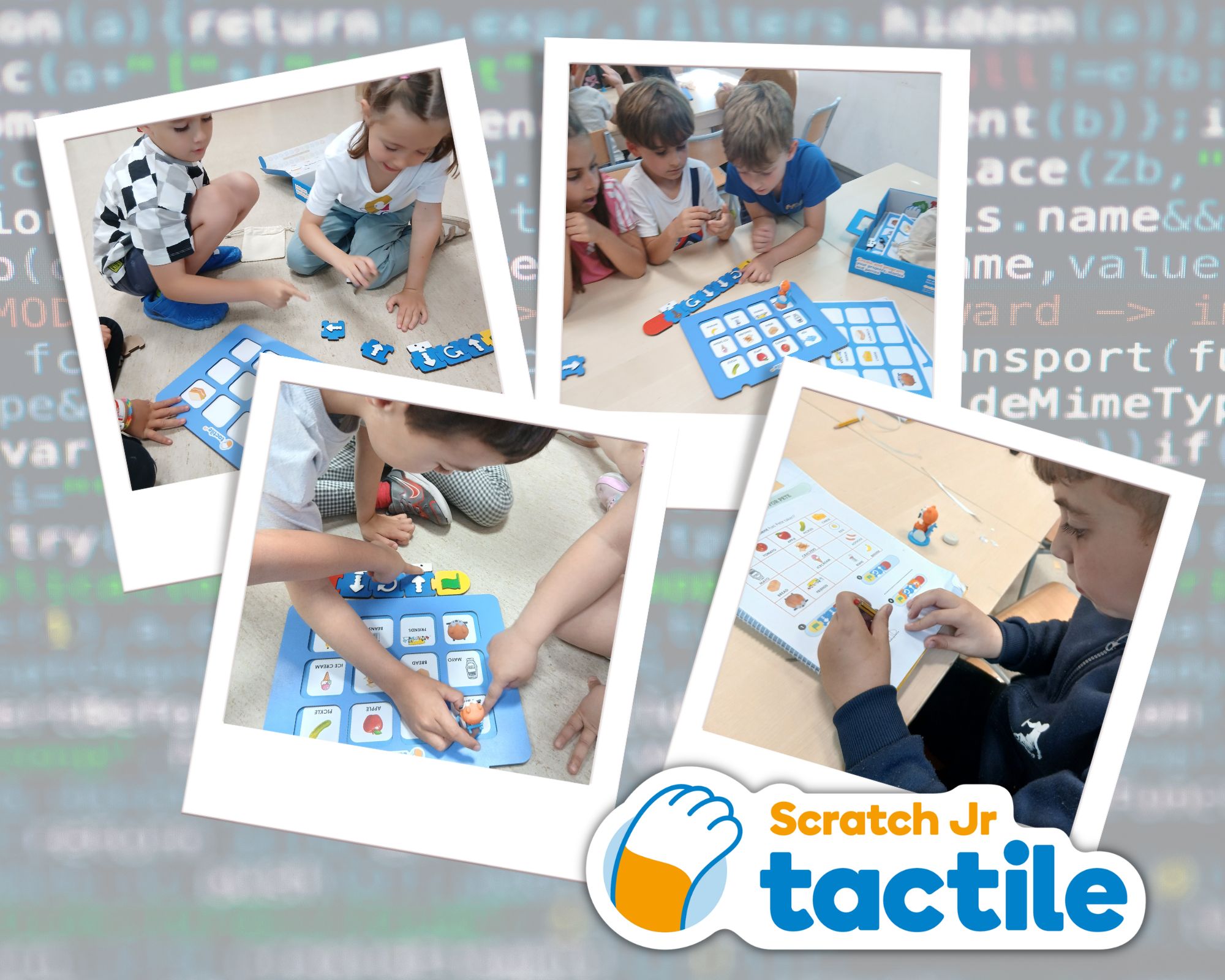
In this case, the problem we were facing was to lead Pete through a labyrinth collecting the necessary ingredients to make his sandwich. The activity involved different steps: remembering the ingredients of the story and its order, locating them in the maze and imagining the best way to reach them.
Once this was done, it was time to give the instructions… in English! We learned the words GO FORWARD, GO BACKWARDS, TURN LEFT and TURN RIGHT.
All these words implied movement, so the best way to memorize them was moving while we said the words. We played different games moving around the class in line, in pairs and it was so fun!

With the vocabulary learnt, it was time to give PETE the instructions using the wooden pieces in the Scratch Jr game. The game consisted of a board in which, in groups, we had to move Pete using algorithms. It seemed very easy at first but we soon faced the first problems: we were not sure of the directions in which Pete had to turn and we did not have a lot of pieces. When faced with these problems it was time to analyze and find the solution in groups.
We now know how to give Pete instructions in both English and algorithm so we are ready to try with real robots? Will we be able to program them? Of course!