



Teaching Art History in the second year of Batxillerat 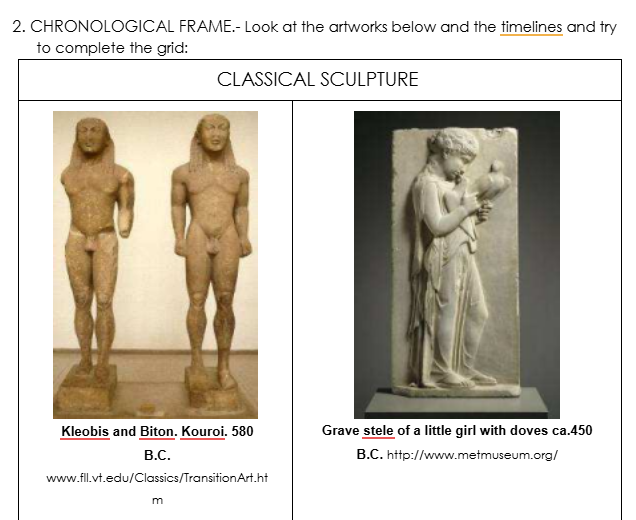 offers a unique opportunity to combine historical knowledge, visual analysis and critical thinking. In this context, an activity focused on Classical Greek and Roman art was carried out using English as the working language, with the aim of reinforcing both artistic understanding and linguistic competence.
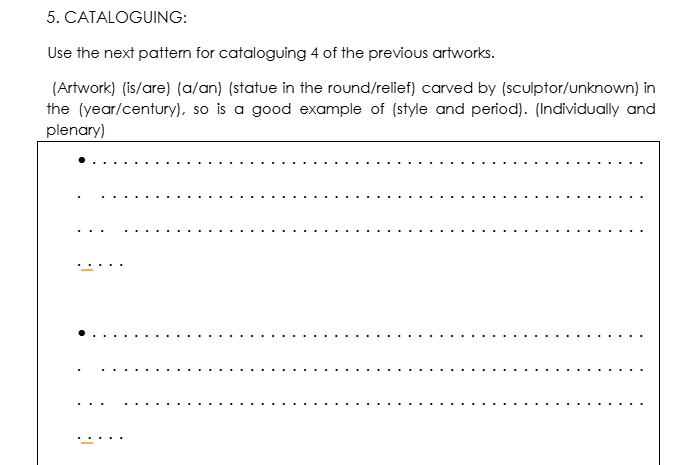 The activity introduced students to the main characteristics of Classical Greek art, emphasising ideals such as harmony, proportion and balance. Through the analysis of sculptures and architectural works, students explored how Greek artists represented the human body in an idealised yet naturalistic way. Works like the Discobolus by Myron or the sculptures of the Parthenon allowed students to reflect on movement, anatomy and the search for perfect beauty. Architecture was also analysed through the study of the Doric, Ionic and Corinthian orders, helping students understand how form and symbolism were closely linked in Greek culture.
The second part of the activity focused on Roman art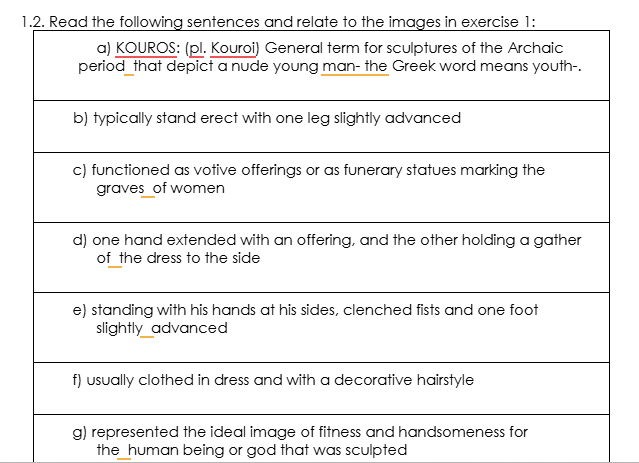 and its relationship with Greek models. Students learned that, although Roman artists adopted many Greek artistic forms, they adapted them to their own values and needs. Roman sculpture, especially portraiture, was studied as a reflection of realism, power and social status. Architectural achievements such as the use of the arch, the vault and concrete were key elements in understanding how Roman art combined functionality, engineering and political propaganda. Monuments like the Colosseum and the Pantheon served as clear examples of these ideas.
One of the most enriching aspects of the activity was the comparison between Greek and Roman art. Students were encouraged to identify similarities and differences in style, purpose and cultural meaning, using specific art-related vocabulary in English. This approach helped them express complex ideas while reinforcing their understanding of historical context.
Working in English also played an important role in student engagement. Using a foreign language to analyse artworks encouraged active participation and improved confidence when speaking about art. The interdisciplinary nature of the activity showed students that art history is not an isolated subject, but one that connects language, culture and history.
In conclusion, teaching Classical Greek and 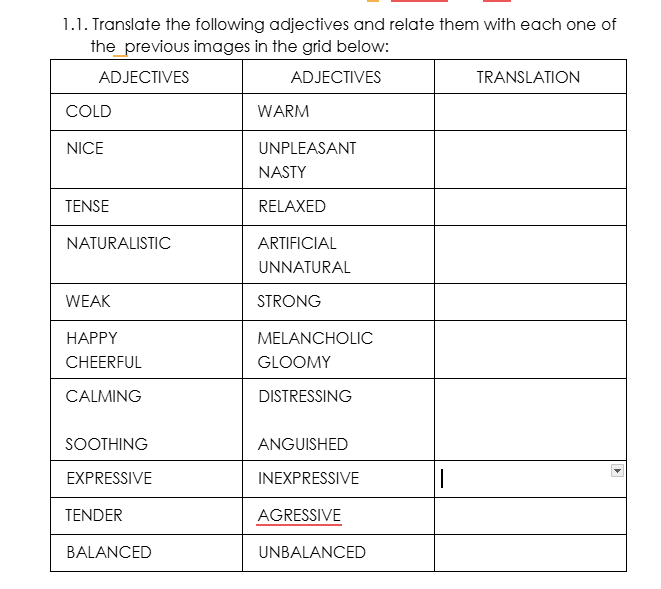 Roman art through English has proved to be a valuable educational experience. It has helped students develop analytical skills, broaden their cultural knowledge and improve their use of academic English. Classical art remains essential for understanding the roots of Western culture, and approaching it through an active and interdisciplinary methodology makes learning both meaningful and engaging.
A 2n de Batxillerat hem treballat l’art grec i romà mitjançant anglès, dins d’un enfocamentAICLE. L’activitat ha permès analitzar escultures i arquitectura clàssica, comparant l’idealització grega amb el realisme i la funcionalitat romana.
Els estudiants han utilitzat vocabulari específic d’art en anglès, expressant idees complexes i comprenent millor el context històric. Treballar continguts i llengua estrangera junts ha fet l’aprenentatge més actiu, significatiu i interdisciplinari.