

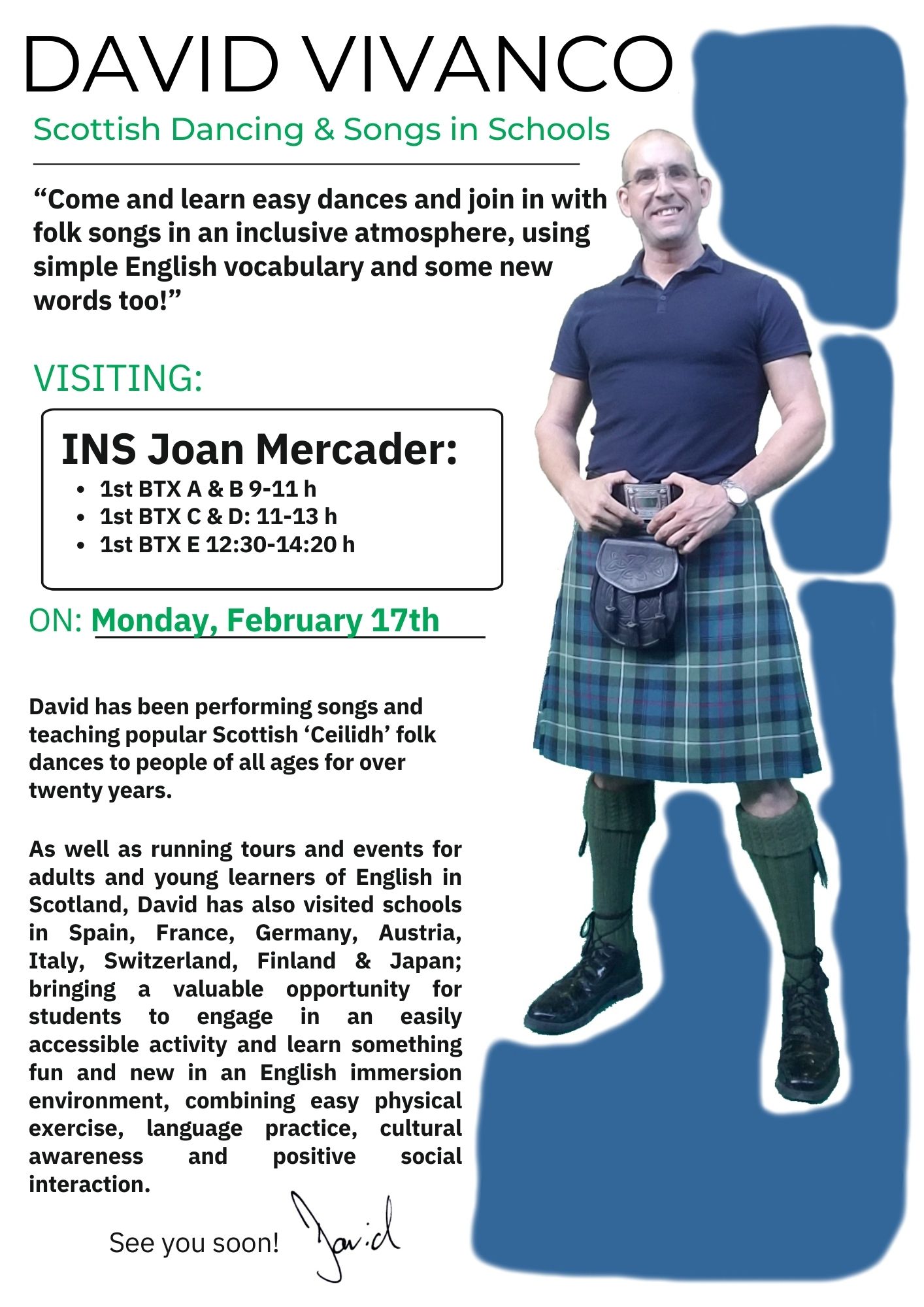
From Caledonia, the Roman name for Scotland, alluding to the tribe living to the north of the River Forth whose “cal” strong, “donia” feet fought against, and stopped the Roman invasion of Scotland, the artist David Vivanco descendant of this true brave Scottish tribe took 1st BTX students and teachers through a trip across the history, music, art and of course, dances of the land to the north of England known as Scotland nowadays. We would like to thank students and teachers for their participation and cooperation in this workshop, masterly led by David Vivanco with his expertise and knowledge about his homeland.


A céilidh is the traditional Gaelic social dance in Scotland, Ireland and Atlantic Canada. Other spellings encountered are ceilidh, céilí (Irish reformed spelling) and cèilidh (Scottish Gaelic reformed spelling). Before discos and nightclubs, there were Céilidhs in most town and village halls on Friday or Saturday nights; they are still common today.
Originally céilidhs facilitated courting and prospects of marriage for young people and although discos and nightclubs have displaced céilidhs to a considerable extent, céilidhs are very popular in rural parts of Ireland and in Scotland (especially in the Gaelic-speaking west coast regions). It is common for some clubs and institutions such as sports clubs, schools and universities and even employers to arrange céilidhs on a regular or at least annual basis. The formality of these can vary. Some mix modern pop music with a Scottish country dancing band and dress codes range from compulsory Highland Dress to informal clothing. Knowledge and use of the basic dance steps is not always strictly necessary and dances often alternate with songs, poetry recitals, and story telling.
Céilidh music is often provided by an assortment of fiddle, accordion, flute, tin whistle, pipes, bodhrán (Irish drum)