We cannot say that the health emergency situation for covid19 is overcome. In the midst of the vaccination campaign, the emergence of new variants of the SARS-Cov2 coronavirus means that the disease continues to prevent us from returning to the dynamics that were common before the outbreak of the pandemic. In this situation, the third mobility of the Erasmus + Progression project from school to adulthood in SEN has had to be proposed in virtual format.
This third meeting took place on 14th, 16th and 18th June 2021 and our partners from Leeds (UK) hosted it. The differences in the distribution of the school calendar became quite obvious: we were immersed at the end of the course while our British partners were still looking forward to more than a school month before concluding the course at the end of July.
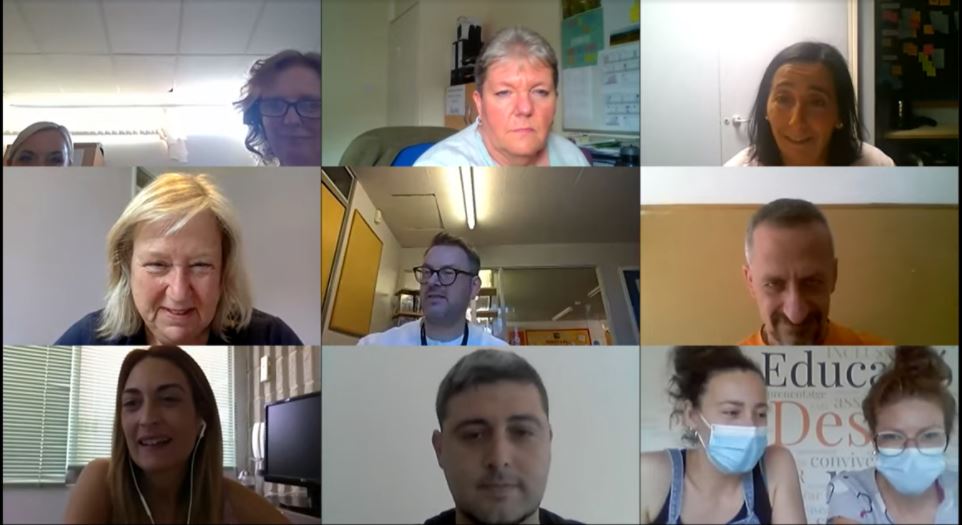
On the first day of the meeting, after the welcome by Diane Reynard (Executive Principal of East SILC), we participated in two presentations. Firstly, Jamie Darby (Phase leader of the 16-19 years) spoke about the goals that are intended to be achieved in that stage and showed us evidence of the results achieved by the students. Through different employment statistics and data on grades and standards achieved by students we were able to realize that the situation between both contexts (Catalan and British) are perfectly comparable. Next, Kate Parlett (Lighthouse school) explained aspects related to disability legislation and its impact on post-16 education. With her extensive experience of more than two decades he was able to explain to us how ideas can be made to become realities.
On Wednesday, June 16, they held the second session. Bridie Dorning (Head of John Jamieson & Brigshaw School) was in charge of welcoming us. Kat Simpson then led the session with a comprehensive presentation of the Engagement model, an assessment tool undertaken by the UK government to help schools perform their support functions for student who are working below the standard of National Curriculum assessments. This model is articulated around 5 areas: exploration, realization, anticipation, persistence and initiation.
The third session took place on Friday 18 June. After the welcome by Diane Reynard (Executive Principal of East SILC) we developed 3 conferences. First of all, Jamie Darby (Phase leader of the 16-19 years) and Bridie Dorning (Head of John Jamieson & Brigshaw School) were tasked with explaining how to develop and improve student resilience through of their resume in the 16-19 age stage. The use of Thrive Approach and the design of all sorts of experiences were described in his exposition. Next, Diane Reynard described the current situation of educational care for special educational needs students, highlighting the sharp increase in students that has occurred in recent years and the present and future challenges that this entails, as well, such as plans and strategies in order to give a quality response.
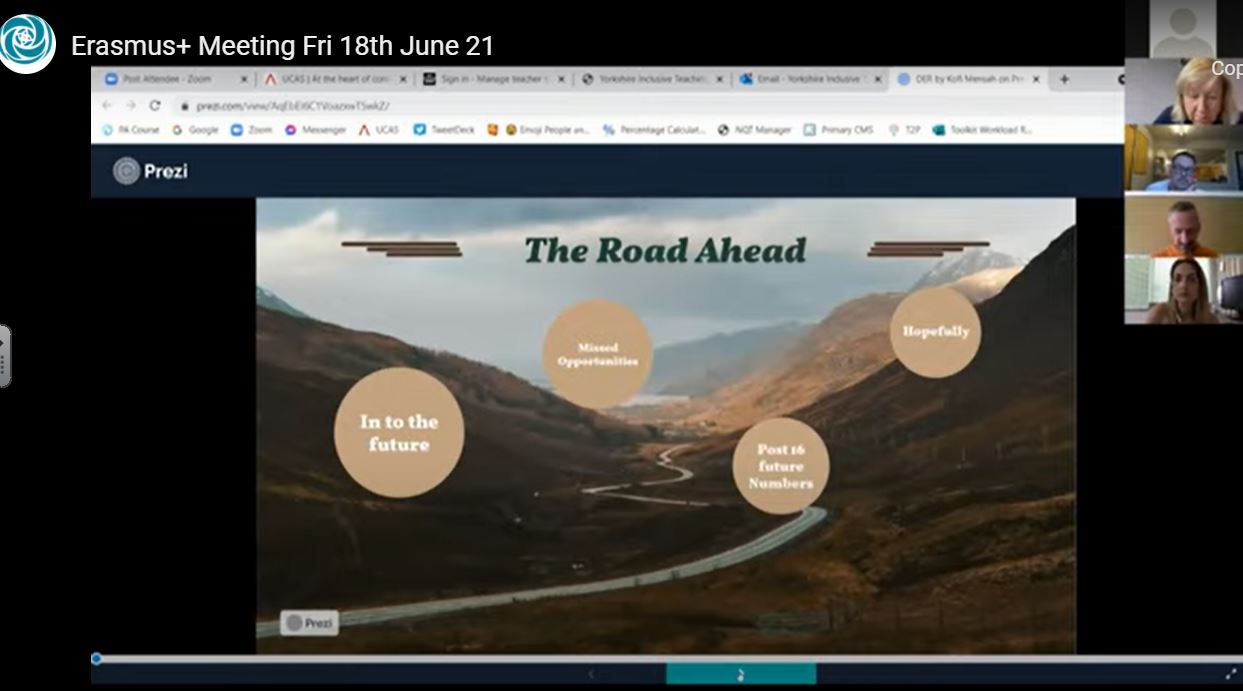
Finally, Jan Linsley (Edeucation) coordinated the plenary on how the objectives of the project have been so far, the planning of the last mobility of the project and how to ensure a wide dissemination of the project.
We thus concluded the third mobility of the Erasmus + project and together we set out to continue working so that despite Brexit, the pandemic for covid19 and any contingency that may arise, the desire to share, the commitment around the attention to people and the will around the pursuit of excellence are goals shared by all project partners and the premises to continue walking together.