The iceberg model
Violence sometimes starts with a ‘meaningless’ act which is often ignored. Individual acts of heteronormative/sexist/ homophobic/ transphobic/ interphobic and otherwise derogatory and hurtful language, ‘jokes’ or comments, may seem ‘benign’, harmless, even well-meaning and not aiming to hurt. Consequently, such language and behaviours are often bypassed in lieu of normalization: in the context of patriarchal norms, such behaviours are thought to be rational responses and ones that often seem ‘normal’ and ‘ justifiable’.
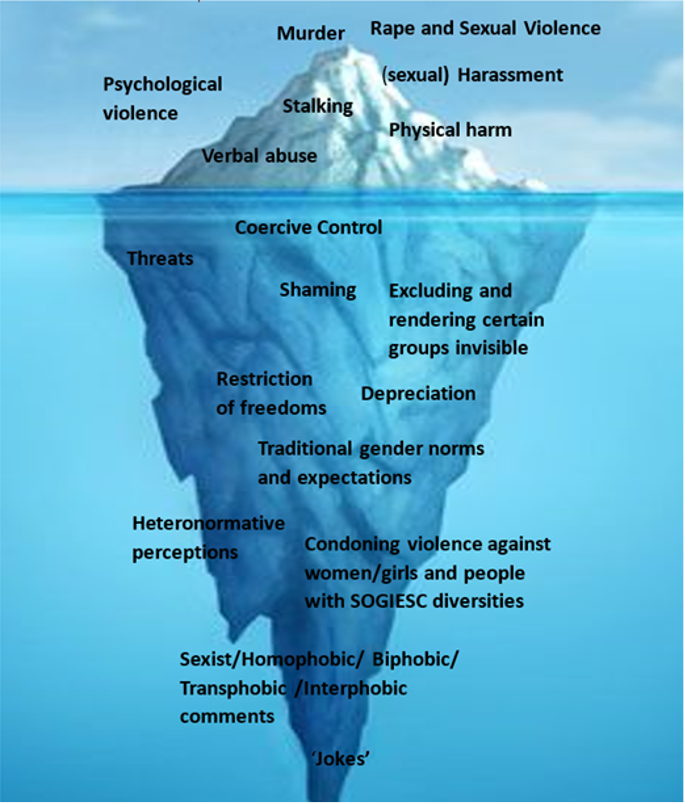
Taking a look at the picture of the iceberg below, we can see that while it is easier for us to recognize the more overt manifestations of violence such as murder, rape, sexual violence, physical abuse and verbal abuse, we often remain oblivious to the hurtful impact of the more covert manifestations of violence. Derogatory language or jokes, practices that render certain groups invisible, shaming, isolation and exclusion, among others, are practices that lay at the bottom of the iceberg, because they are not easily recognized as hurtful, racist and abusive. However, it is these practices that constitute an overall climate of disrespect of diversity and human rights violations and give rise to all the behaviours that lie at the visible part of the iceberg. Such behaviours, when put together as different parts of a puzzle over time, synthesize a vivid, powerful and coherent picture, that of sexism, homophobia, transphobia, biphobia, interphobia and gender-based and sexual violence in all its forms.
The common thread amongst these hurtful attitudes, beliefs and behaviours is the thread of hostile/hegemonic masculinity and patriarchal norms which overshadow and violate the rights, needs, dignity and safety of girls, women, people with SOGIESC diversities and all groups at risk of SGBV. Allowing these behaviours to go unnoticed and unaddressed as human rights violations, creates the impression that such types of violence can be tolerated, thus cultivating an environment which perpetuates inequality, discrimination, prejudice, abuse and oppression.
The more certain jokes, stereotypes, and normative perceptions about gender, gender roles, gender identities, gender expressions and sexual/romantic attractions are overlooked, the more they can brew intimidation, dominance, fear and insecurity. This leads not only to a culture of acceptance and the condoning of gender-based and sexual violence, but often creates a fruitful ground for violence to escalate from the most covert forms (jokes, comments, invisibility etc) to the most overt forms (physical harm, rape, sexual violence and murder).